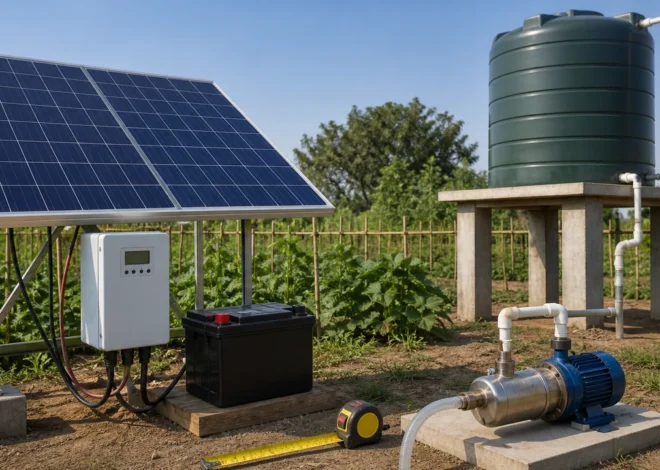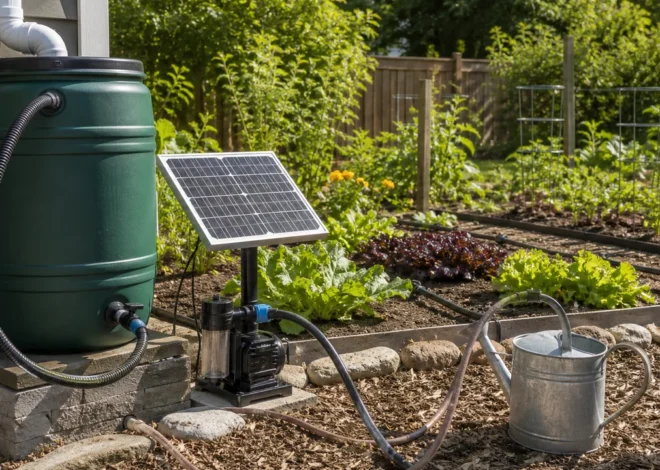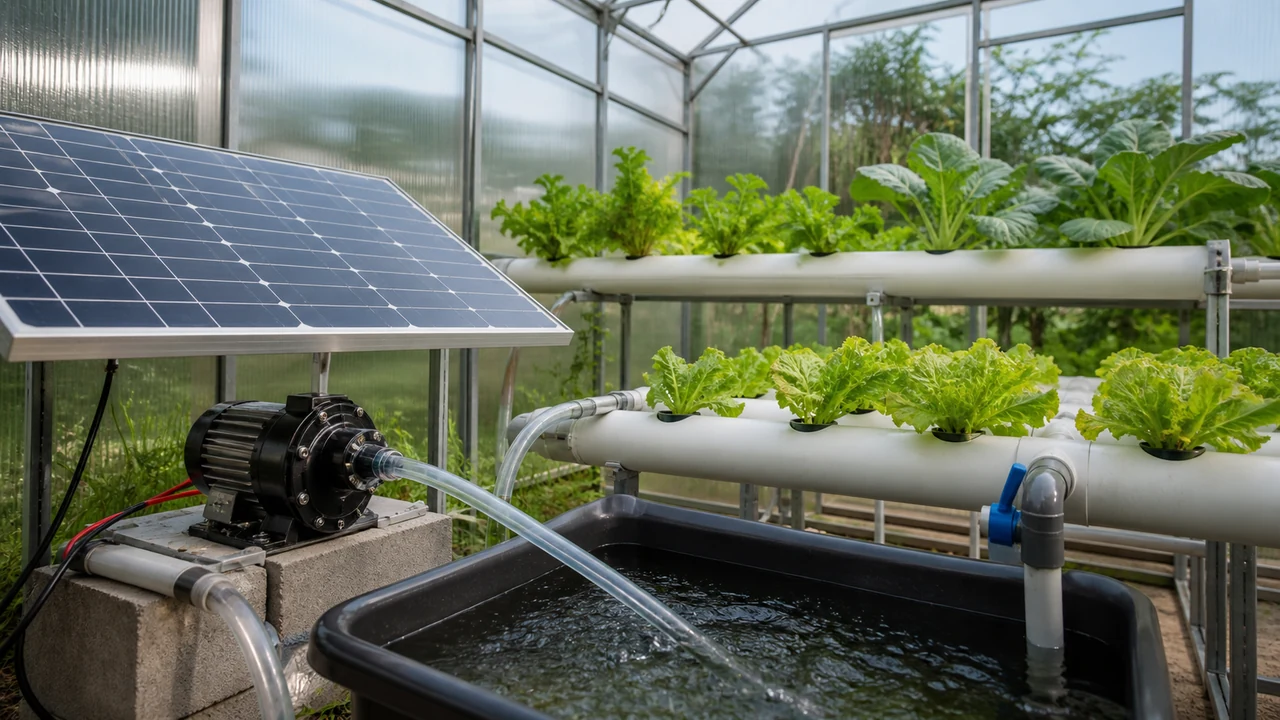
Best Solar Water Pump for Hydroponics: 8 Solar and Backup Options Compared
Most costly pump mistakes are installation mistakes in disguise. A restricted line, lost prime, crowded float, dirty intake, or mismatched control can defeat a motor that looked ideal in the listing. Those details are central to a solar water pump for hydroponics, where plant count or zone GPM, reservoir size, daily runtime, panel location, head, and emitter pressure determine whether the pump will work as intended.
GARDENA AquaBloom Solar Irrigation Set stands out for a branded tank-and-pump kit for small automatic watering; choose JIYANG Solar Drip Irrigation Kit when the job is small container, greenhouse, or rain-barrel irrigation. The change in duty is material, not a minor variation in the same product class.
The product notes translate those specifications into practical buying decisions. Plant demand, reservoir size, emitter pressure, panel exposure, and runtime determine whether water arrives when needed. A pump earns its place here only when its published design fits the liquid, route, controls, and duty cycle in question.
Quick Answer: Match Solar Output to the Watering Schedule
Among the products reviewed here, GARDENA AquaBloom Solar Irrigation Set is the clearest all-around pick for container gardens and greenhouse pots without a nearby faucet. The important point is that it offers a branded tank-and-pump kit for small automatic watering; the listed profile is solar irrigation kit with 10.5-liter tank and up to 20-plant class. JIYANG Solar Drip Irrigation Kit serves small container, greenhouse, or rain-barrel irrigation, and ECO-WORTHY Solar Well Pump Kit 100W/12V covers a low-demand off-grid well or remote storage tank.
Comparison Table
| Model | Best use | System format | Main check |
|---|---|---|---|
| GARDENA AquaBloom Solar Irrigation Set | container gardens and greenhouse pots without a nearby faucet | solar irrigation kit with 10.5-liter tank and up to 20-plant class | The tank needs refilling based on weather and plant demand. |
| JIYANG Solar Drip Irrigation Kit | small container, greenhouse, or rain-barrel irrigation | solar drip kit with integrated pump/controller and low-water or idle alarm format | The plant count and run time are limited by the small reservoir and panel. |
| ECO-WORTHY Solar Well Pump Kit 100W/12V | a low-demand off-grid well or remote storage tank | 12V solar well kit with 100W panel, 1.6 GPM class, and 230-foot maximum-head class | Daily output depends on sunlight and storage, not maximum head alone. |
| ECO-WORTHY Solar Well Pump Kit 200W/24V | a higher-demand remote well or storage system | 24V solar well kit with two 100W panels and 3.2 GPM class output | The pump still needs storage because cloud cover changes daily output. |
| ECO-WORTHY 24V 250W Solar Pump Kit | a tank-fed remote water system or small farm installation | 24V solar pump kit with 250W class input, 1,500 L/h and 98-foot class head | The stated flow is dependent on head and available solar input. |
| JENENSERIES 270W/24V Solar Pump | farm, garden, and remote storage pumping | 24V, 270W stainless solar deep-well pump format with MPPT-controller class | The useful daily output still depends on the pump curve, sunlight, and storage plan. |
| ECO-WORTHY Solar Well Pump Kit 400W | a remote well or farm water system with a larger solar array | 24V panel-and-controller deep-well kit format | Cloudy periods and a small reservoir limit the watering window. |
| Amarine-made 24V DC Submersible Deep-Well Pump | remote well or tank filling from a DC power system | 24V submersible format in the 3.2 GPM and 230-foot maximum-lift class | Maximum lift is not the same as useful flow at a working head. |
Best Tank-and-Drip Kit: GARDENA AquaBloom Solar Irrigation Set

GARDENA AquaBloom Solar Irrigation Set is best understood through its intended job. It is meant for container gardens and greenhouse pots without a nearby faucet, with a branded tank-and-pump kit for small automatic watering and solar irrigation kit with 10.5-liter tank and up to 20-plant class defining the useful operating range.
A buyer using GARDENA AquaBloom Solar Irrigation Set should confirm the tank, daily water demand, panel placement, and drip tubing are accessible. That matters because plant demand, reservoir size, emitter pressure, panel exposure, and runtime determine whether water arrives when needed.
If container gardens and greenhouse pots without a nearby faucet describes your project, GARDENA AquaBloom Solar Irrigation Set has a credible case. It becomes less attractive when this limitation applies: The tank needs refilling based on weather and plant demand.
Pros
- The included 10.5-liter tank helps a small garden operate away from a tap.
- The up-to-20-plant class gives a useful scale reference.
- The integrated solar pump and panel reduce component matching work.
- Drip delivery is gentler and more efficient for pots than a fountain nozzle.
Cons
- The tank needs refilling based on weather and plant demand.
- The kit is for small-scale irrigation, not a well, pond, or household pressure system.
Bottom line: Buy GARDENA AquaBloom Solar Irrigation Set for container gardens and greenhouse pots without a nearby faucet, not as a general replacement. The practical constraint is this: The kit is for small-scale irrigation, not a well, pond, or household pressure system.
Check the current price and availability
Best Small Plant Kit: JIYANG Solar Drip Irrigation Kit

On a project involving small container, greenhouse, or rain-barrel irrigation, JIYANG Solar Drip Irrigation Kit deserves attention for a concrete reason. It is listed as solar drip kit with integrated pump/controller and low-water or idle alarm format and brings an integrated low-flow watering kit for potted plants to that role.
One practical check comes first: the reservoir, emitters, panel exposure, and plant count fit the kit. Plant demand, reservoir size, emitter pressure, panel exposure, and runtime determine whether water arrives when needed.
The product suits small container, greenhouse, or rain-barrel irrigation, but it is not a universal pump. Buyers should allow for these two tradeoffs: The plant count and run time are limited by the small reservoir and panel. It is not a household water-supply or deep-well pump.
Pros
- The integrated controller keeps a small drip setup simple.
- Low-water and idle alerts can protect a pump fed from a small reservoir.
- The kit is sized around potted plants rather than a high-flow sprinkler zone.
- Anti-siphoning behavior is useful when the tank sits above the emitters.
Cons
- The plant count and run time are limited by the small reservoir and panel.
- It is not a household water-supply or deep-well pump.
Bottom line: The recommendation holds for small container, greenhouse, or rain-barrel irrigation. It becomes less convincing when this limitation matters: The plant count and run time are limited by the small reservoir and panel.
Check the current price and availability
Best Low-Demand Well Kit: ECO-WORTHY Solar Well Pump Kit 100W/12V

Unlike a generic pump, ECO-WORTHY Solar Well Pump Kit 100W/12V is built around a low-demand off-grid well or remote storage tank. The combination of a complete panel, controller, and submersible kit for a modest daily demand and 12V solar well kit with 100W panel, 1.6 GPM class, and 230-foot maximum-head class explains why it belongs in this particular comparison.
A buyer using ECO-WORTHY Solar Well Pump Kit 100W/12V should confirm the source depth, storage tank, battery plan, and sunlight hours are calculated. That matters because plant demand, reservoir size, emitter pressure, panel exposure, and runtime determine whether water arrives when needed.
For a low-demand off-grid well or remote storage tank, this model offers a clear path when the installation matches. Pay particular attention to this limitation: The 12V wiring, controller, and dry-run protection need careful planning.
Pros
- The 100W panel and 12V system make a remote installation easy to define.
- The 1.6 GPM class suits storage-tank filling rather than continuous household peak demand.
- A stated 230-foot maximum-head class provides a starting boundary for the design.
- The kit format keeps panel, controller, and pump selection together.
Cons
- Daily output depends on sunlight and storage, not maximum head alone.
- The 12V wiring, controller, and dry-run protection need careful planning.
Bottom line: ECO-WORTHY Solar Well Pump Kit 100W/12V is best reserved for a low-demand off-grid well or remote storage tank. One practical point to budget for is The 12V wiring, controller, and dry-run protection need careful planning.
Check the current price and availability
Best for Higher Solar Demand: ECO-WORTHY Solar Well Pump Kit 200W/24V

ECO-WORTHY Solar Well Pump Kit 200W/24V is best understood through its intended job. It is meant for a higher-demand remote well or storage system, with more panel input and 24V wiring for a larger daily water requirement and 24V solar well kit with two 100W panels and 3.2 GPM class output defining the useful operating range.
A buyer using ECO-WORTHY Solar Well Pump Kit 200W/24V should confirm the well yield, panel placement, storage, and controller are matched. That matters because plant demand, reservoir size, emitter pressure, panel exposure, and runtime determine whether water arrives when needed.
For a higher-demand remote well or storage system, ECO-WORTHY Solar Well Pump Kit 200W/24V is a sound candidate when the rest of the system matches. The main limitation is this: The pump still needs storage because cloud cover changes daily output.
Pros
- The two-panel package supplies more solar input than a small 100W kit.
- The 24V system can reduce current on a longer DC cable run.
- The 3.2 GPM class gives a higher-demand off-grid comparison.
- A complete kit simplifies the first pass at panel and pump compatibility.
Cons
- The pump still needs storage because cloud cover changes daily output.
- The well yield and setting depth must be checked rather than inferred from the panel wattage.
Bottom line: As a match for a higher-demand remote well or storage system, ECO-WORTHY Solar Well Pump Kit 200W/24V is a reasonable pick. The detail that can change the decision is this: The pump still needs storage because cloud cover changes daily output.
Check the current price and availability
Best Mid-Range Remote Irrigation: ECO-WORTHY 24V 250W Solar Pump Kit
On a project involving a tank-fed remote water system or small farm installation, ECO-WORTHY 24V 250W Solar Pump Kit deserves attention for a concrete reason. It is listed as 24V solar pump kit with 250W class input, 1,500 L/h and 98-foot class head and brings a mid-range 24V kit for useful lift without a full household system to that role.
One practical check comes first: the panel/controller package and daily storage demand are matched. Plant demand, reservoir size, emitter pressure, panel exposure, and runtime determine whether water arrives when needed.
ECO-WORTHY 24V 250W Solar Pump Kit is worth considering for a tank-fed remote water system or small farm installation. Keep these two practical limits in view: The stated flow is dependent on head and available solar input. The pump needs a compatible controller and a storage plan for changing sunlight.
Pros
- The 24V architecture suits a moderate off-grid cable run.
- The 1,500 L/h and 98-foot class gives a concrete comparison point.
- The kit is more suitable for tank filling than a decorative solar fountain.
- The panel and pump are sold as a coordinated system.
Cons
- The stated flow is dependent on head and available solar input.
- The pump needs a compatible controller and a storage plan for changing sunlight.
Bottom line: If a tank-fed remote water system or small farm installation is your situation, ECO-WORTHY 24V 250W Solar Pump Kit is worth considering. Keep this tradeoff in view: The pump needs a compatible controller and a storage plan for changing sunlight.
Check the current price and availability
Best MPPT-Style Farm Option: JENENSERIES 270W/24V Solar Pump

Unlike a generic pump, JENENSERIES 270W/24V Solar Pump is built around farm, garden, and remote storage pumping. The combination of a stainless 24V kit with MPPT-style controller and 24V, 270W stainless solar deep-well pump format with MPPT-controller class explains why it belongs in this particular comparison.
A buyer using JENENSERIES 270W/24V Solar Pump should confirm the controller, panels, source depth, and storage tank are matched. That matters because plant demand, reservoir size, emitter pressure, panel exposure, and runtime determine whether water arrives when needed.
Its strongest use is farm, garden, and remote storage pumping. The tradeoff is concrete: The useful daily output still depends on the pump curve, sunlight, and storage plan. A second point to allow for is Storage and dry-run protection remain necessary for intermittent sun.
Pros
- The stainless pump body suits a submerged remote-water environment.
- The 24V system can keep cable current manageable.
- An MPPT-style controller can make better use of changing solar input when included.
- The product gives a farm-oriented alternative to household AC well pumps.
Cons
- The useful daily output still depends on the pump curve, sunlight, and storage plan.
- Storage and dry-run protection remain necessary for intermittent sun.
Bottom line: JENENSERIES 270W/24V Solar Pump is a sensible purchase for farm, garden, and remote storage pumping when the route and controls are already defined. The main qualification is this: The useful daily output still depends on the pump curve, sunlight, and storage plan.
Check the current price and availability
Best for a Larger Array: ECO-WORTHY Solar Well Pump Kit 400W
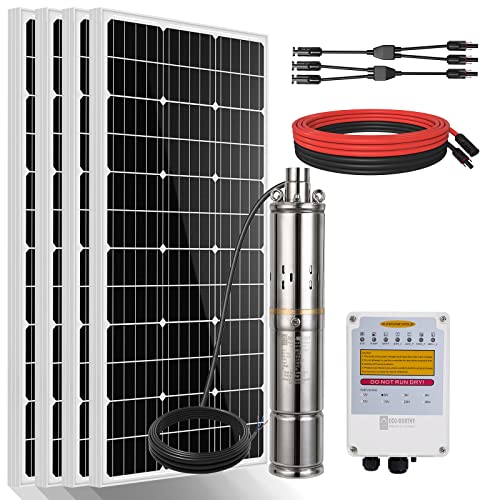
ECO-WORTHY Solar Well Pump Kit 400W is best understood through its intended job. It is meant for a remote well or farm water system with a larger solar array, with a higher-input solar kit for greater lift or daily demand and 24V panel-and-controller deep-well kit format defining the useful operating range.
A buyer using ECO-WORTHY Solar Well Pump Kit 400W should confirm the panel array, controller, storage tank, and well depth are designed as one system. That matters because plant demand, reservoir size, emitter pressure, panel exposure, and runtime determine whether water arrives when needed.
If a remote well or farm water system with a larger solar array describes your project, ECO-WORTHY Solar Well Pump Kit 400W has a credible case. It becomes less attractive when this limitation applies: Cloudy periods and a small reservoir limit the watering window.
Pros
- The larger solar input gives a remote system more daily pumping potential.
- The 24V format is better suited to a longer DC wiring plan than a tiny 12V kit.
- The kit can be evaluated around storage and total dynamic head.
- It gives off-grid buyers a step up from small fountain-style solar products.
Cons
- Cloudy periods and a small reservoir limit the watering window.
- A large array cannot compensate for a low-yield or poorly screened source.
Bottom line: ECO-WORTHY Solar Well Pump Kit 400W makes sense for a remote well or farm water system with a larger solar array if the surrounding equipment accommodates it. One limitation remains: A large array cannot compensate for a low-yield or poorly screened source.
Check the current price and availability
Best 24V Pump Comparison: Amarine-made 24V DC Submersible Deep-Well Pump

On a project involving remote well or tank filling from a DC power system, Amarine-made 24V DC Submersible Deep-Well Pump deserves attention for a concrete reason. It is listed as 24V submersible format in the 3.2 GPM and 230-foot maximum-lift class and brings a compact DC pump with a deep-lift class to that role.
One practical check comes first: the immersion depth, controller, cable, and battery or panel output are adequate. Plant demand, reservoir size, emitter pressure, panel exposure, and runtime determine whether water arrives when needed.
The product suits remote well or tank filling from a DC power system, but it is not a universal pump. Buyers should allow for these two tradeoffs: Maximum lift is not the same as useful flow at a working head. The DC controller and dry-run protection must be provided or matched.
Pros
- The 24V input fits a battery-based water system.
- The 3.2 GPM class is useful for storage-tank filling.
- The 230-foot class gives the buyer a high-lift boundary to investigate.
- The submersible format avoids surface suction losses.
Cons
- Maximum lift is not the same as useful flow at a working head.
- The DC controller and dry-run protection must be provided or matched.
Bottom line: The product’s strongest case is remote well or tank filling from a DC power system, not every nearby job. Its practical compromise is this: Maximum lift is not the same as useful flow at a working head.
Check the current price and availability
What Matters When Buying a solar irrigation pump
Protect emitters and pump
Filter the water, keep the intake clear, and use low-water or dry-run protection when the source is a barrel or small reservoir.
Define the irrigation scale
Count pots and emitters for a drip kit, or calculate zone GPM for sprinklers. A well pump is unnecessary for a small tank-fed garden.
Measure lift and pressure
Include tank height, slope, hose length, filter, regulator, and emitter pressure. Small drip systems can fail from too much or too little pressure.
Plan the solar window
Decide whether watering happens during sunlight or from stored energy. Panel location and seasonal shade affect the schedule. The same check keeps the pump from being asked to serve a neighboring category.
Use a reservoir when possible
A tank can buffer variable sun and let a small pump run during a predictable period instead of chasing every faucet or valve demand.
A watering-schedule check
Multiply emitter flow by the number of open emitters and the planned runtime. A 20-emitter line at 0.5 GPH uses 10 gallons per hour, which can be compared directly with the reservoir and solar charging window.
Before Programming the Watering Cycle
When you need a solar water pump for hydroponics, make the final decision with plant count or zone GPM, reservoir size, daily runtime, panel location, head, and emitter pressure written down. The pump has to work in the water path that will exist after the hose, filter, valve, basin, or control is connected.
If the installation looks closer to container gardens and greenhouse pots without a nearby faucet, start with GARDENA AquaBloom Solar Irrigation Set. If it resembles remote well or tank filling from a DC power system, the last model may be the more sensible route. The category boundary still matters in both cases.
Test with the normal number of emitters open and the reservoir at its usual level. That reveals whether the garden receives water during the actual schedule.
Frequently Asked Questions
Can a solar irrigation pump draw from a well?
Only when it is a well-rated pump with the proper controller, depth, and source protection. A larger field or sprinkler zone needs a different pump and controller design.
Can a solar pump run drip irrigation?
Yes. A small solar drip kit or a 12V diaphragm pump can work when flow, pressure, filter, and reservoir are matched.
How many plants can a solar irrigation kit water?
Use the current kit’s plant or emitter guidance and account for weather and refill frequency. A filter protects small emitters from sediment and algae.
Can a solar irrigation pump run sprinklers?
Larger solar systems can, but a tiny pot-watering kit will not provide sprinkler flow or pressure. A larger field or sprinkler zone needs a different pump and controller design.
Do I need a battery for solar irrigation?
A battery is optional in some systems. A reservoir often provides a simpler buffer for a garden schedule.
How do I prevent emitter clogging?
Use a cleanable filter, keep the tank covered, and flush the drip lines as recommended. A filter protects small emitters from sediment and algae.
Final recommendation: If I were narrowing this list for this job, I would begin with GARDENA AquaBloom Solar Irrigation Set and then move to JIYANG Solar Drip Irrigation Kit or ECO-WORTHY Solar Well Pump Kit 100W/12V only when their distinct use cases fit the site. Those alternatives cover small container, greenhouse, or rain-barrel irrigation and a low-demand off-grid well or remote storage tank; the governing checklist is plant count or zone GPM, reservoir size, daily runtime, panel location, head, and emitter pressure.